Wednesday, May 4, 2016

No comment from Congressman Tim Ryan on "STOP Act"

Congressman Tim Ryan
(photo courtesy of timryan.house.gov)

By Matt Poe

U.S. Congressman Tim Ryan (D) of the 13th District of Ohio was unable to be reached for comment on House Resolution 4443. The resolution, more commonly referred to as the "STOP Act" was proposed by Rep. David Jolly (R) of Florida's 13th District as a resolution to prohibit elected members of Congress from directly soliciting campaign contributions for finance and reelection.

"Americans wonder why we haven't defeated ISIS, secured our border, provided health care for veterans, or balanced our budget," Jolly states on the STOP Act's homepage.

"Here's why. Too many people in Washington are more focused on raising money than doing the job you elected them to do," Jolly said.

The bill was introduced in the House on February 3, 2016 and amends the Federal Election Campaign Act of 1971 to prohibit an individual holding federal office from soliciting funds directly from any person: (1) for or on behalf of any political committee, or (2) for or on the behalf of any person for use for federal election activity, according to the details of the resolution. The latest action taken by sponsors and cosponsors of the bill was "sponsor introductory marks on measure," according to congress.gov.
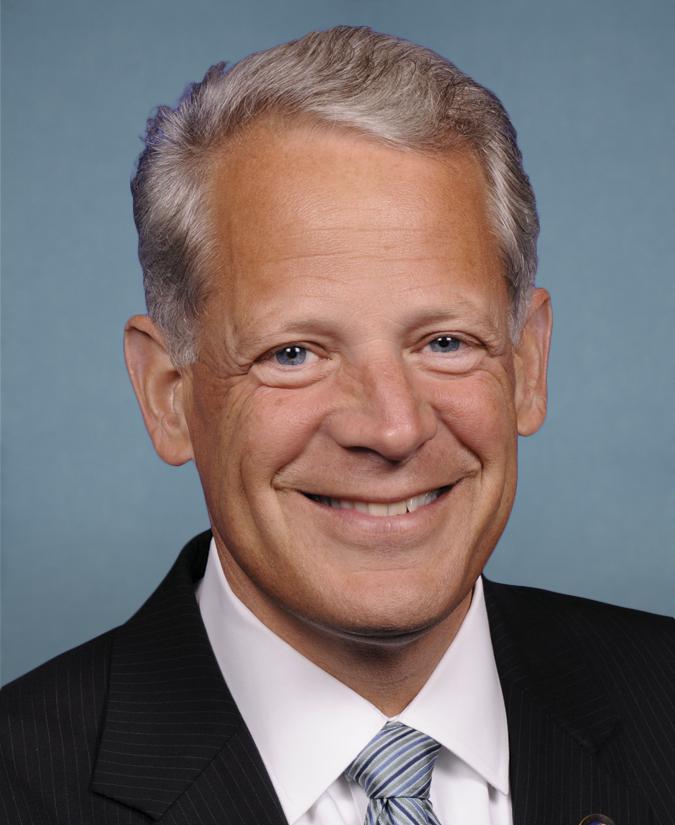
Congressman Steve Israel
(photo courtesy of congress.gov)
The bill is just one measure of campaign finance that representatives and constituents continue to address in 2016. Campaign finance, in general, has become one of the major issues during the 2016 general election, most notably addressed by Democratic presidential candidate and Vermont Sen. Bernie Sanders. While the STOP Act does not address campaign solicitations at the executive level, it does address the issue at the legislative level.

Congressman Steve Israel (D) of New York's 3rd District penned an op-ed in The New York Times in January 2016, detailing the revelations of how much time elected officials can spend asking for contributions.

"Since then, I've spent roughly 4,200 hours in call time, attended more than 1,600 fundraiser just for my own campaign and raised nearly $20 million in increments of $1,000, $2,500 and $5,000 per election cycle," Israel told The New York Times.

"And things have only become worse in the five years since the Supreme Court's Citizens United decision, which ignited an explosion of money in politics by ruling that the government may not ban political spending by corporations in elections," Israel said.

A graphic from thestopact.com depicting a schedule distributed by the
Democratic Congressional Campaign Committee (DCCC).
As for reaching out to Mr. Ryan, several phone calls were sent to the congressman's office and neither him nor his press aide or communications director was able to be reached for comment. An email was also sent out to Congressman Ryan's communications director, Michael Zetts, and another member of his staff as well. The House of Rep. was in session on May 3, the only day of session for the House of Rep. in May.

For more information on the STOP Act, visit http://www.thestopact.com/


Matt Poe
(photo courtesy of KentWired.com)


Elected officials often get into politics for the right reasons. On a local level, it can be much easier for officials to represent their constituents in a manner in which both sides can mutually benefit. However, often times when officials finally make it to Washington, D.C., they become so entrenched in the bids for reelection, amongst other things, that they forget the reason they were elected in the first place: to serve the people. To spend this much time a day asking for money is outrageous and shows why the legislative process is so slow. Representatives need to help solve problems for constituents, not ask for their money.

Tuesday, May 3, 2016

Congressman Brad Wenstrup's Opinions on Dialing for Dollars

Congressman Brad Wenstrup (R)- 2nd District    
In order to raise enough money for the campaign trail, members of Congress must call donors anywhere from 25 to 30 hours a week. On an episode of “60 Minutes”, Florida Representative David Jolly introduced a bill to ban federal-elected officials from dialing for dollars called the Stop Act.

Congressman of the 2nd District in Ohio, Brad Wenstrup (R), had an opinion about the dialing for dollars and the Stop Act.

When doing a radio interview on 55KRC, Wenstrup was asked about the amount of time these members of Congress spend per day and per week calling people for fund money.

“Well that’s not my world, that’s for sure,” Wenstrup said. “I might spend two hours a month making phone calls.”

Still from "60 Minutes" episode
Wenstrup explains that instead of calling these donors for money, he actually uses the time to hear from the people and get their opinions.

“I like to use that as a tool actually because I like to hear from a lot of constituents and what’s on their mind; how the government usually is not working well for them,” he said.

Although the Congressman did not completely object to the amount of time spent dialing for dollars, he says the amount of time seems practically unmanageable.

“5 hours a day is virtually impossible, I sit on 3 committees and 6 sub-committees,” Wenstrup said. “4 or 5 hours a day is impossible, but I appreciate the intent.”

The Congressman explains how dialing for dollars does not only effect members of Congress and the funds for their campaigns, but it also has effects on citizens.

“Well anecdotal stories, true stories if you will, that people are telling you make an impact on you when you want to be able to say ‘Look, do you realize the consequences of what’s taking place here in Washington and what it’s doing to the people in the community?’” he said.

Wenstrup was questioned about when he first came into office and if he was given instructions and expectations to make these phone calls, regardless of the lack of time on his schedule.

“What I see, in some way there’s an effort to be a team and help those who are having tough races, but no one has ever dictated to me anything that I had to do as far as my campaigning, that’s up to me,” Wenstrup said.

This does not mean the Congressman doesn’t have anyone calling to campaign for him.

“We have people who work on the campaign side and do a lot of that and so the time I spend on it is very minimal because I just don’t have that much time,” he said.

With all of this being said, Congressman Wenstrup’s office did not provide a finite answer on whether or not he approves or opposes the Stop Act. However, he did make it known that a large portion of his time is not spent dialing for dollars.

Listen to the interview below:
--------------------------------------------------------------------------------------------


Megan Deierling-Reporter


The fact that members of Congress are dialing for dollars makes me wonder if they really care about the people when they campaign or if they see people as dollar amounts. It also has me speculating what other things members of Congress do to raise money and how much real time they spend working for the people.

NO Response from Jim Jordan on the Stop Act


Jim Jordan’s Office did not respond to our request for his stance on the Stop Act. I contacted the office by phone and email on Thursday April 28, 2016 after viewing the 60 minutes’ report on the Stop Act.


As 60 Minute's reported the Stop Act is a bill, to stop the dialing for dollars fundraising technique. This popular way of raising funds is in place currently by both major parties. Members of Congress are expected to put 25 hours a week fundraising to get reelected. The 60 minutes’ report stated that congressman needs to collect 18 thousand dollars per week in donations. They are placed in call centers near the Capital Building to sit and call list of possible donors.


When calling the Washington office the  secretary informed me that press secretary Darin Miller, the press secretary was out of the office, on Thursday. After leaving a voicemail on Millers phone and sending a very simple email asking Miller, Jordan’s stance on the Stop Act. We received NO response from the office by our deadline Monday May 2nd.


--------------------------------------------------------------------------------------------------------------------------

I personally believe it is wrong that congress is spending so much time fundraising. If I tried to do such a thing at work, I would be fired in a minute. Who is holding congress accountable, why isn't more reporting being done on this topic. The overall opinion on congress is at an all time low, I wonder why, when they are not fighting for the American people. Also we elect these officials, when they don't respond on such a hot topic it shows in my opinion they don't care. 

How do Congressmen Spend Their Time?


The Stop Act was put forward in January, to stop the hours of phone time members of Congress spend calling to raise money, or "dialing for dollars". The act prohibits member of Congress from directly soliciting campaign contributions. 

60 Minutes reported that party members are recommended to spend four hours a day in calling booths, in an effort to raise money. 

After hearing the 60 Minutes report, the computer-assisted reporting class at Kent State University decided to contact members of Congress' press aids to find out their members views on the Stop Act.

Congressmen Robert Brady's Chief of Staff, Stanley White spoke on Brady's behalf.

Robert "Bob" Brady
U.S. Representative for Pennsylvania's 1st congressional district


White said that Congressman Brady does not spend any time making fundraising calls. 

"He doesn't make fundraising calls as a rule. He's made two or three on behalf of other members or candidates over the past 16 years. But I don't know of any he's made for his own congressional campaign."

White said that the Congressman has not publicly objected to the amount of time members are expected to spend fund raising, but he did not give an explanation as to why Brady has not objected. 

 White proceeded to say "You might also consider the fact that an elected official from PA might not give a darn about an Ohio student paper reporting that he didn't respond to questioning." 


By: Nadia Assim


========================================================================================================================


I find it very wasteful that dialing for dollars is how the Congressmen are spending their time. There are more pressing issues in our country right now that they should be focused on.
In my effort to get in contact with Congressman Brady, I was very disturbed at the way I was talked to and I do not think Congressmen and their staff need to be so hostile when answering questions. It makes them seem very sneaky, like they are trying to hide something. 


Stop Act; Don't Ask Scott Perry


Scott Perry Member of Pennsylvania's 4th Congressional District
As 60 Minutes reports, it is estimated that each member of Congress spends four hours a day calling to raise money. The Stop Act prohibits elected members of Congress from directly soliciting campaign contributions. The Computer Assisted Reporting class at Kent State reached out to Congressman Scott Perry to see if he was in favor or opposed to the stop act.

United States Congressman David W. Jolly writes in regards to this issue:

"It's time members of Congress stop asking people for money and start doing their jobs."

In trying to reach out to Congressman Perry I received no response, as he declined to comment on the issue of "dialing for dollars."


Sources:
http://www.thestopact.com/
http://www.cbsnews.com/videos/dialing-for-dollars/